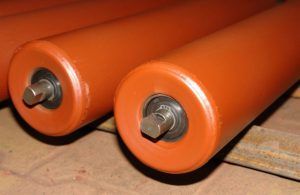
Idlers drag and shape the conveyor belt in the cross-section and, at the same time, adjust it to the required efficiency and the development conditions.
The most frequent diameters of carrier idlers (steel, smooth or ring) are as follows: 51, 60,3, 89, 108, 133, 159 mm.
The most frequent diameters of lower idlers (steel, smooth or disc) are as follows: 89, 108, 133 mm.
– diameters of idlers should be adjusted in such a way that the number of their rotations (“nk”) does not exceed 600 – 700 rpm (recommended: 450 – 550 rpm).
nk = (60 x V) : (3.14 x D)
nk – rotations of idler (1/min)
V – speed of belt (m/s)
D – diameter of idler (m)
It is noteworthy that with an increase in diameter of the idler, there is a decrease in the resistance of the belt’s bending on idlers (essential element of the conveyor’s resistances) and an increase in the durability of bearings (due to a smaller number of rotations at a particular speed).